Biomolecules, like protein and DNA control all the processes that allow us to live. When they malfunction, you're in trouble and we better figure out what's going wrong. But that is not always particularly easy: from many biomolecules we do not understand how they work and why they work so well. To investigate that we should be to inspect them in close-up so that we can observe their function and intricate machinery that makes their little clocks go round.
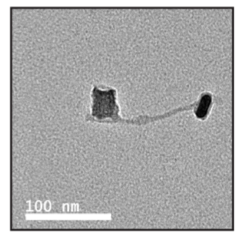
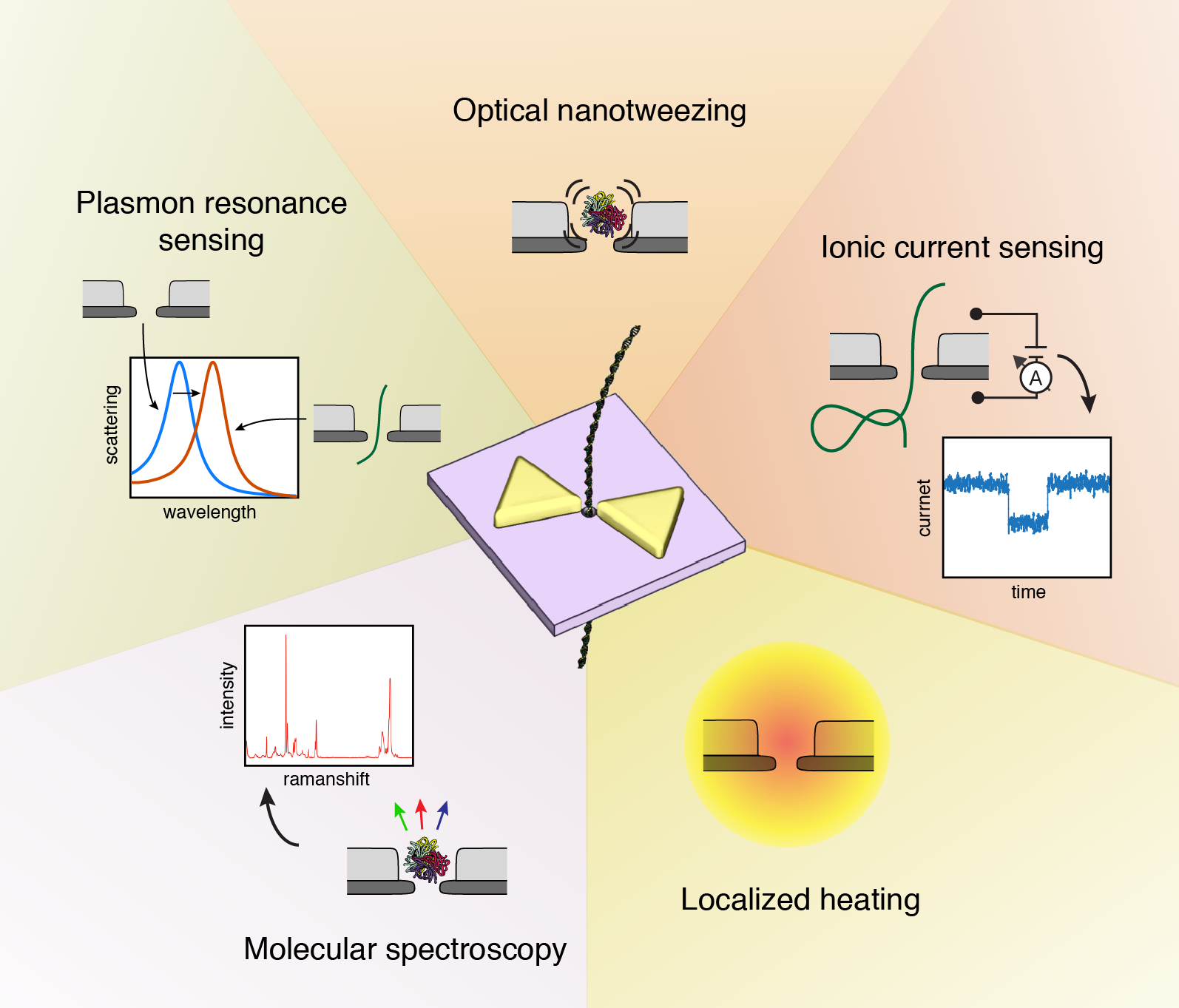
But grabbing a single molecule and inspecting its contents is really hard. Apart from the small size of the objects, biomolecules shake, shimmer, and bounce around a tremendous amount. How can one gently control something that small (without squashing or destroying it) and still be able to tell what it is? I have worked on a practicle solution to tackle that problem during my doctoral research: the plasmonic nanopore sensor to investigate and manipulate single biomolecules. The plasmonic nanopore is constructed from two single-molecule sensing devices merged into one: a solid-state nanopore, a tiny hole in a thin membrane that confines a static electric field, and a plasmonic nanoantenna, a gold nanostructure that concentrates light into nanoscale volumes (hotspots). Using these localized static and optical fields, biomolecules can be captured, trapped, perturbed, manipulated, and probed in a variety of ways. All controlled at will by the experimenter, one single molecule at the time.
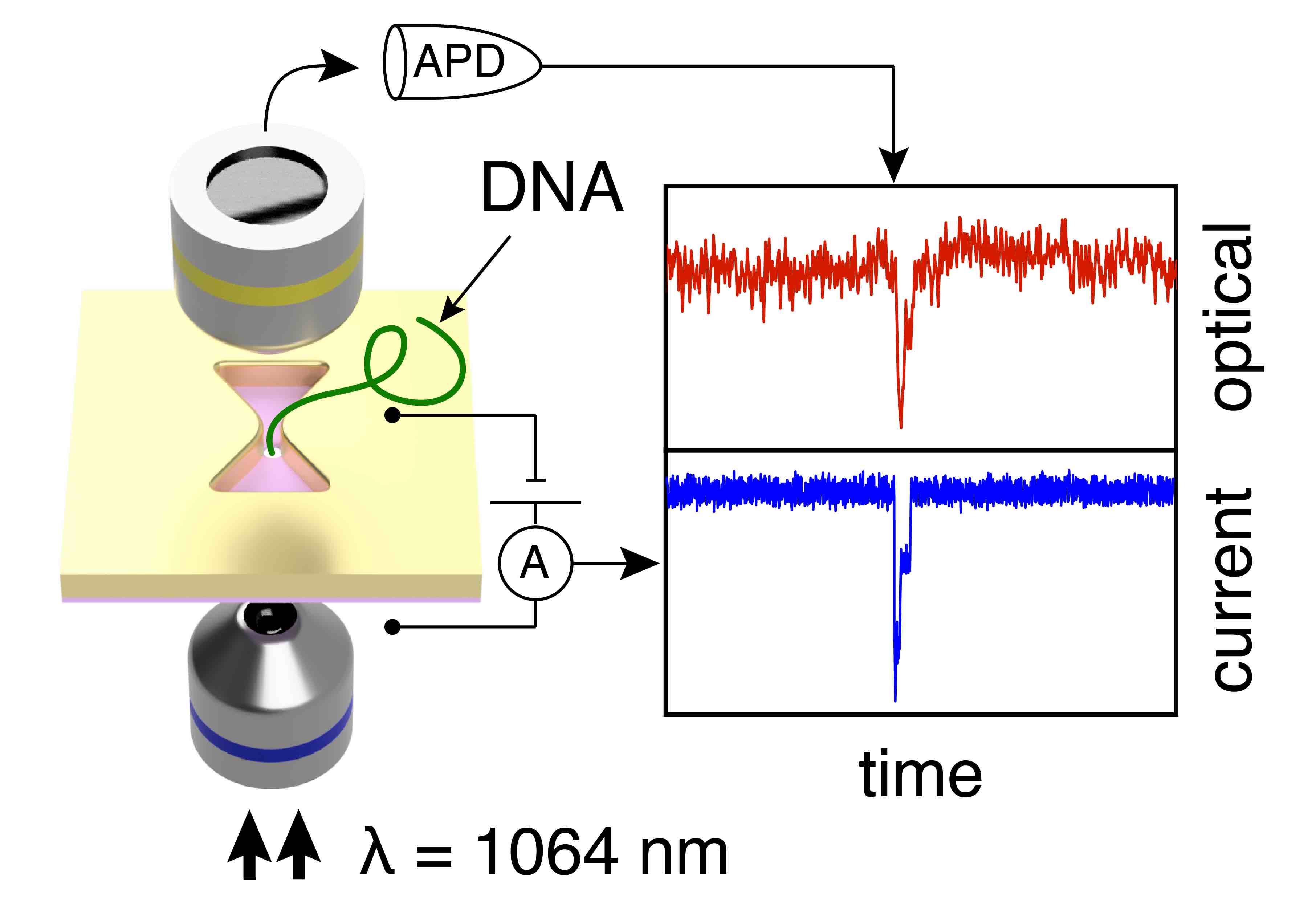
Solid-state nanopores rely on the flow of an ionic current induced by the application of a bias voltage to detection molecules and determine their size. The problem with this scheme is that it intrinsically couples signal strength to the driving voltage, requires the use of high-concentration electrolytes, suffers from capacitive noise, and impairs high-density sensor integration to investigate biomolecules.
With plasmonic nanopores, the dependence on the driving voltage and restriction to buffer conditions is now no longer needed. The enhanced light scattering (or transmission, depending on where your detector is) of a plasmonic nanoantenna on top of the pore can also report on the presencen and size of molecules passing through the nanopore. The presence of the biomolecule causes a shift in the resonance of the antenna that temporarily changes the light scattering properties of the antenna, which can be measured incredibly fast. This label-free optical detection scheme offers opportunities to probe native DNA–protein interactions at physiological conditions.
Have a look at our papers on this if you are interested: Active delivery of single DNA molecules into a plasmonic nanopore for label-free optical sensing and Label-free optical detection of DNA translocations through plasmonic nanopores
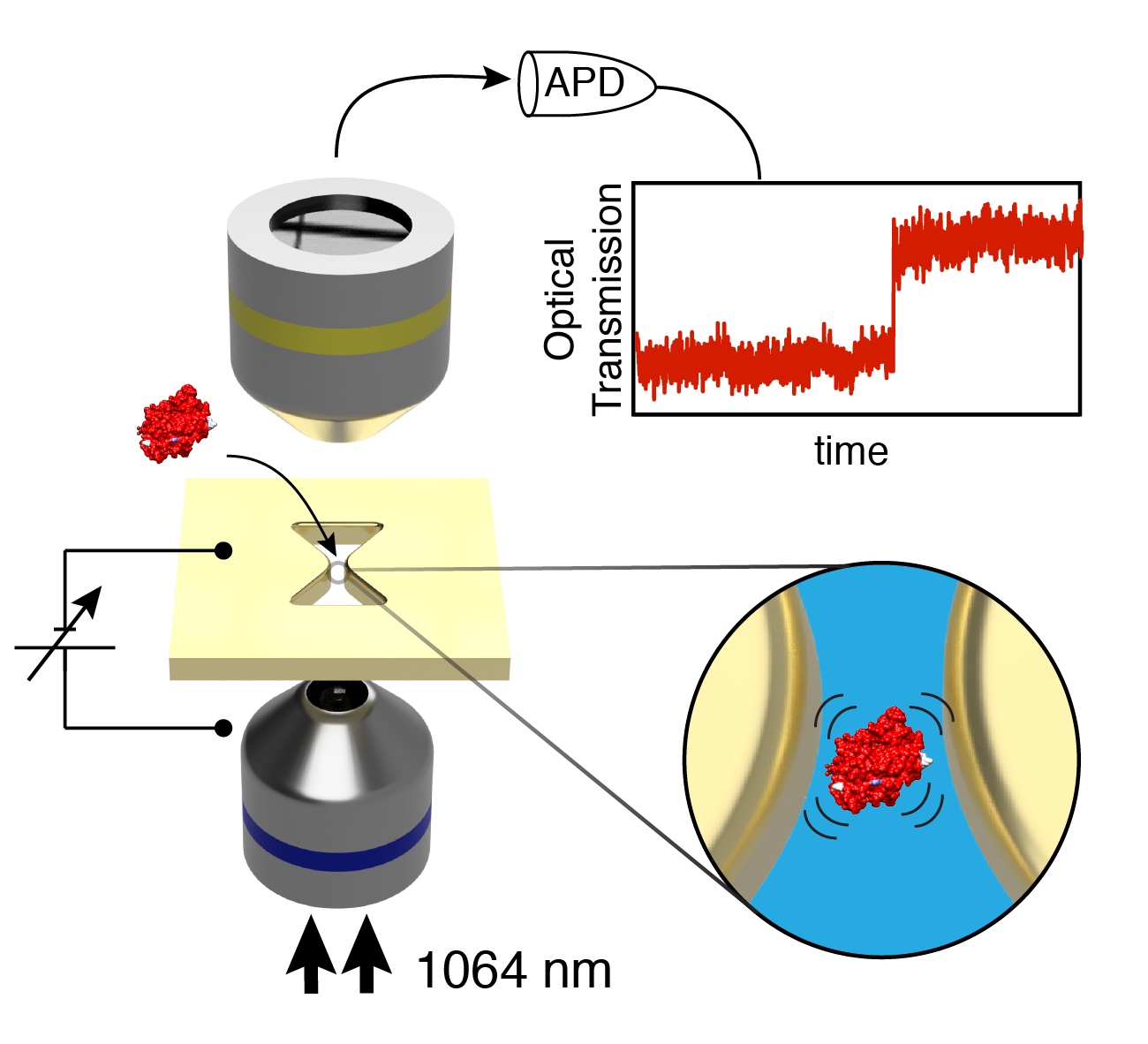
The toolbox of the biophysist does already contain many tools to investigate single molecules, such as an optical tweezer, but almost all of these techniques require chemical modification of the molecule of interest. Grabbing and holding single molecules without modifying them is still an open challenge in biophysics. Retaining and pertubing a molecule at will by the investigator, without any chemical tricks is still not possible.
We have, however, been developing a nanoscale set of tweezers that can do exactly that: a plasmonic nanopore tweezer. Building on the principles of gradient force trapping (much like optical tweezers), our optical hotspots in a plasmonic nanostructure integrated with a nanopore can provide strong enough optical forces to retain large protein molecules. The nanopore is used to attract to and pertub the molecules in the sensor, so that the sensor can be used at high throughput and providing the experimenter with an additional handle of control. But it's not all fun and games: molecules love to interact with the sensor and the fabrication of these small nanostructures is not quite so reliable yet. Future developments will focus on mitigating these effects.
For more info check out: Nano-optical tweezing of single proteins in plasmonic nanopores
see Google Scholar for an updated list.
© D.V., 2019. This website is hosted on Github and made using skeleton: getskeleton.com